
Weather & Environment
WeatherXM D1 — Network Edition
$238.80
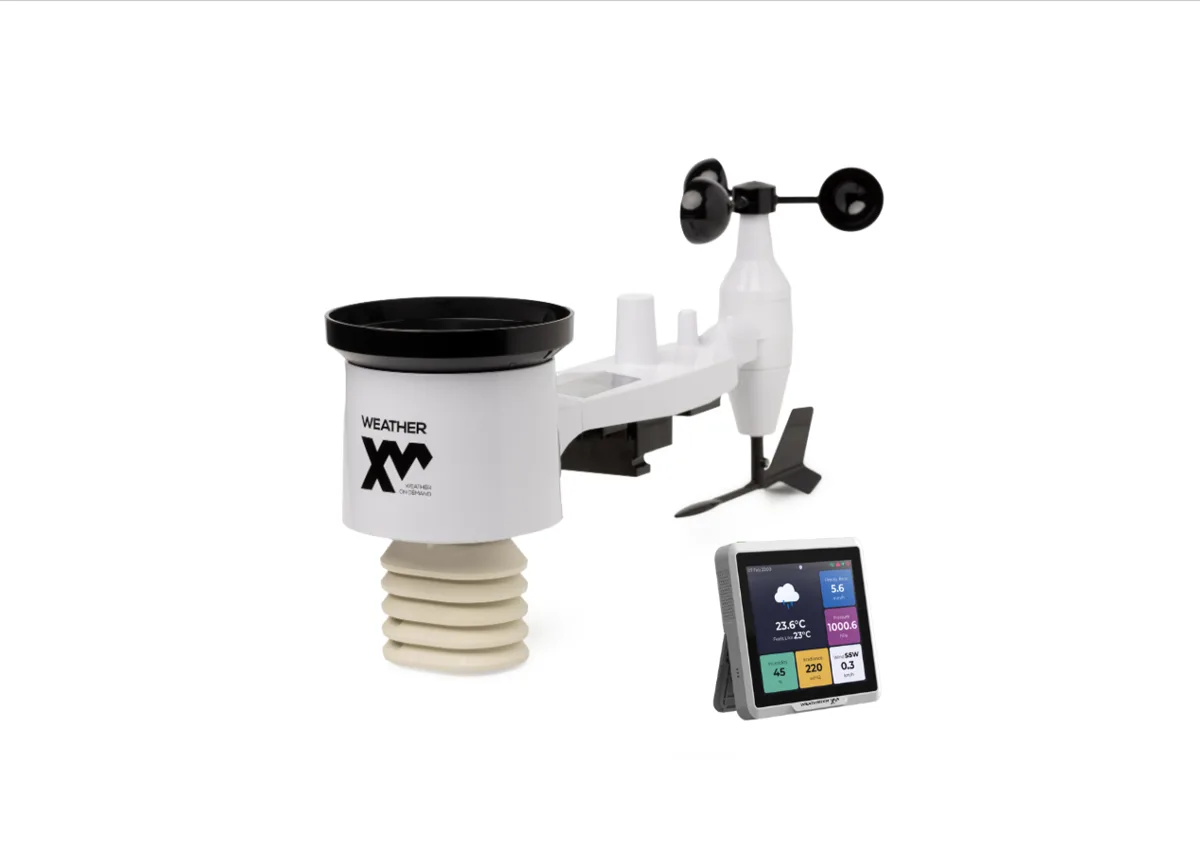
A solar-powered outdoor weather station that measures temperature, humidity, pressure, wind, rain, and light at your home or site. Its readings travel by LoRa to an indoor touchscreen gateway, which connects over Wi-Fi. The Network Edition joins the WeatherXM network and shares its observations there.
Buy Now opens the secure checkout preview. No payment is taken in demo.
Added — view cart
What it does
The D1 is a two-part home and small-site weather station, sold as bundle WB1200. A solar-powered outdoor station (WS1001) measures conditions at your site, and an indoor gateway (WG1200) with a touchscreen console receives those readings and puts them where you can use them. The outdoor station never joins your Wi-Fi itself. It sends a compact reading packet over a private point-to-point LoRa radio link to its own paired gateway, roughly every 20 seconds. The gateway then forwards observations over Wi-Fi about once a minute, shows live conditions on its screen, and serves the same data locally at the same time. The gateway cryptographically protects each observation and its location with a built-in secure element before forwarding, so data leaving the home can be verified as coming from your station. It also logs history locally to a memory card, offers a local web interface and a local network API for home-automation, building and custom software integrations, and can share weather telemetry with nearby mesh radio nodes. In this Network Edition, the station contributes its quality-checked observations to the network it is built for, where they are shown in its companion app and network explorer and made available through that network's data services. The hardware is identical to the Open Edition; this edition is the lower-priced version for stations contributing data under that network's rules. Typical uses include homes, schools and small businesses, gardens and small farms, greenhouses and nurseries, and small facilities that want weather measured at their own address rather than taken from a distant forecast.
How it's used
- Unpack the bundle: outdoor station with wind cups, wind vane and solar panel, indoor gateway with USB-C cable, external battery pack, mounting plate, U-bolts, nuts, wrench, screwdriver, zip ties and bird spikes.
- Assemble the outdoor station, fitting the wind cups, wind vane and rain collector following the assembly guide.
- Insert 2 AA 1.5 V non-rechargeable batteries as backup power. Do not use rechargeable batteries, as they can damage the station. Fit the external battery pack if you want capacity for extra cells (up to 8 AA in total).
- Mount the station outdoors in the open on a metal pole, about 50 mm (2 in) in diameter and at least 2 m (6.56 ft) high, secured with the plate, U-bolts and tools provided. Keep it clear of walls, trees and heat sources that distort wind and temperature readings.
- Place the gateway indoors within LoRa range of the station, ideally near a window facing the station, in a spot with a fairly steady indoor temperature. Keep it permanently powered and switched on so it can receive, record and upload readings.
- Connect the gateway to power with the USB-C cable and a USB power supply (cable included, power adapter not included), then join it to your 2.4 GHz Wi-Fi network.
- Download its companion app, claim the station and gateway, and confirm the pairing. The gateway can be set to listen for its saved station, or paired locally.
- Check the gateway touchscreen and the app to confirm live readings are arriving, and confirm the gateway's local web interface loads on your home network.
Everyday use: Leave both parts running. The station samples continuously outdoors on solar power with battery backup, and the gateway shows live weather tiles, trend charts and daily minimum and maximum values on its touchscreen. The same live and recent readings are available in the companion app, in the gateway's local web interface with live and 24-hour charts, and to local software through the local network API, with no internet round trip needed for local reads. History is also written to the gateway's memory card as a local record. The gateway can additionally act as an environmental sensor for nearby mesh radio nodes, sharing your station's wind, rain and pressure readings even if the internet is down. Firmware updates arrive over the air in stages, and can also be installed over USB.
Key specs
- Components: WS1001 outdoor station + WG1200 indoor gateway (bundle WB1200)
- Measurements (7-in-1): temperature, relative humidity, barometric pressure, wind speed, wind direction, rainfall / rain rate, light (including solar radiation and UV information derived from light sensing)
- Temperature: -40 to +60 °C range; accuracy ±0.2 °C; resolution 0.1 °C
- Relative humidity: 10% to 99% range; accuracy ±5%
- Rain: 0 to 300 mm/h range; accuracy ±10%; resolution 0.254 mm
- Wind speed: 0 to 50 m/s range; accuracy ±1 m/s at wind speeds below 5 m/s
- Wind direction: 0 to 359 degrees
- Light: 0 to 200,000 lux range; accuracy ±15%
- Pressure: 300 to 1100 hPa range (equivalent to about +9,000 m to -500 m relative to sea level); accuracy ±3.9 Pa; resolution 0.06 Pa
- Station sampling / uplink: packet about every 20 seconds to its gateway; gateway forwards over Wi-Fi every 1 minute
- Station link: LoRa point-to-point, sub-GHz, EU868 / US915 / AS923 regional options; up to about 1 km line of sight to its paired gateway
- Station power: integrated solar panel with 2 × AA backup; external battery pack included for extra cells; 1.5 V non-rechargeable batteries only
- Gateway display: 4-inch (3.95-inch) capacitive touchscreen, with live weather tiles, trend charts and daily extremes; integrated barometric pressure sensor
- Gateway connectivity: 2.4 GHz Wi-Fi, Bluetooth Low Energy, LoRa receiver
- Gateway power: USB-C, requires continuous USB power; USB-C cable included, USB power adapter not included
- Gateway security and location: ATECC608 secure element for cryptographic protection of observations; GPS
- Gateway storage: microSD card slot for permanent local weather history logging
- Gateway interfaces: cloud forwarding over Wi-Fi; local web user interface on the LAN; local HTTP REST API on the LAN; mesh environmental telemetry; Bluetooth
- Gateway firmware: over-the-air updates; USB installation also supported
- In the box: WS1001 station with wind cups, wind vane and solar panel; WG1200 gateway with USB-C cable; external battery pack; mounting plate, U-bolts, nuts, wrench, screwdriver, zip ties, bird spikes
- Size and weight (boxed kit): 44 × 17 × 27 cm; 2 kg
Good to know
You will also need AA 1.5 V non-rechargeable batteries, a USB power supply for the gateway, a metal mounting pole (about 50 mm diameter, at least 2 m tall) and the tools and parts to secure the pole; none of these are included. Rechargeable batteries must not be used in the station. Choose the correct regional frequency option (EU868, US915 or AS923) for your location when ordering. Real LoRa range depends on the site: up to about 1 km needs clear line of sight, and concrete, metal and coated glass reduce it, so a gateway position near a window facing the station works best. The gateway needs a 2.4 GHz Wi-Fi signal (5 GHz-only networks will not work for it) and must stay powered on to receive and upload readings. Place the gateway where indoor temperature stays relatively steady through the day for the most reliable pressure readings. Local web access, the local API and memory-card logging work on your own network; cloud features in the companion app need an internet connection.